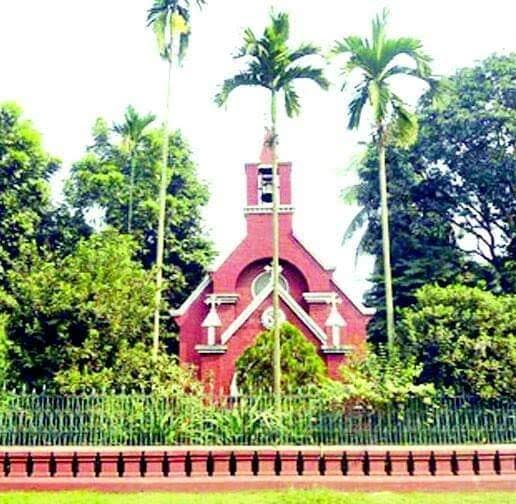
Standing quietly in the railway township of Saidpur, Nilphamari, the Saidpur Railway Catholic Church is one of the oldest Christian landmarks in northern Bangladesh. Closely tied to the history of the railway and colonial-era urban growth, the church reflects how faith, labour, and migration shaped Saidpur into a unique, plural town.
Location and Urban Context
The church is located near Saidpur Railway Station, at the heart of what was once a major railway hub of British India. Saidpur itself emerged as a railway town in the late 19th century, attracting workers, engineers, and officials from different parts of the subcontinent—and with them, diverse religious institutions.
The proximity of the church to the railway line is not symbolic alone; it defines the very reason for its existence.
Historical Background
The Saidpur Railway Catholic Church was established during the British colonial period, primarily to serve European railway officials, Anglo-Indian families, and Christian railway workers stationed in Saidpur. Catholic missionaries, supported by the railway administration, played a key role in organizing worship and community life for the growing Christian population.
Like much of Saidpur’s early infrastructure—railway quarters, schools, clubs—the church grew out of the needs of a mobile, working population connected to the railways.
Architecture and Design
Architecturally, the church is modest yet elegant. It follows a simplified colonial ecclesiastical style rather than elaborate Gothic grandeur. The structure is built with brick masonry, high ceilings, and arched openings designed to allow ventilation in the North Bengal climate.
Key architectural features include:
- A rectangular nave with a pitched roof
- Tall arched windows that allow soft daylight into the interior
- Minimal decorative elements, emphasizing function and solemnity
- A simple altar, reflecting missionary-era pragmatism
The design reflects the practical ethos of railway architecture—durable, restrained, and fitting for a working town rather than a grand colonial capital.
Cultural and Social Significance
For the Christian community of Saidpur, the church has long functioned as more than a place of worship. It became a space of social connection, education, and continuity—especially for families linked to railway service across generations.
The church also stands as a reminder that Saidpur’s identity was shaped by migration and multicultural coexistence. Alongside mosques, temples, gurudwaras, and later civic institutions, the church contributed to a shared urban fabric rooted in mutual presence rather than separation.
Saidpur, Railways, and Community Memory
Railways brought not only trains but also new forms of social life to Saidpur. The church carries memories of Christmas masses attended by railway families, of hymns blending with whistle sounds of passing trains, of a town shaped by schedules and signals.
Even as the railway’s importance declined over time, the church remained—anchoring a shrinking yet resilient Christian community.
Present Condition and Legacy
Today, the Saidpur Railway Catholic Church continues to hold regular services and special observances like Christmas and Easter. While its congregation is smaller than in the colonial or early post-Partition years, the building remains active and cared for.
As urban expansion and memory gaps threaten older heritage structures, the church stands quietly—less photographed than grand temples or mosques, yet deeply woven into Saidpur’s story.
A Living Landmark
The Saidpur Railway Catholic Church is not monumental in scale, but it is monumental in meaning. It tells the story of a town born of rails, of people who arrived, stayed, or moved on—and of faith practiced quietly at the margins of history.
In the rhythm of trains passing by, the church continues its vigil: steady, enduring, and unmistakably part of Saidpur’s soul.