A Comprehensive Feature Report
Location and Setting
The Nayabad Mosque is located in Nayabad village of Kaharole Upazila in Dinajpur district, northern Bangladesh. The mosque stands on the western bank of the Dhepa River, only a short distance from the renowned Kantanagar (Kantaji) Temple. This close physical proximity is not incidental—it reflects a deeper historical and cultural connection between the two monuments.
Surrounded by quiet agricultural land, the mosque today appears modest and restrained, yet its presence anchors the village in a long and layered past of shared craftsmanship, faith, and local memory.
Historical Background
The mosque dates back to the late 18th century, commonly attributed to around 1793 CE during the reign of Mughal emperor Shah Alam II. Historical interpretations suggest that Nayabad Mosque was built by Muslim artisans who had been employed in the construction of the Kantanagar Temple, one of Bengal’s most elaborate terracotta Hindu temples.
After the completion of work on the temple, many of these craftsmen settled in Nayabad village. As practicing Muslims, they required a dedicated space for daily prayers. The construction of the mosque thus emerged out of a practical religious need, supported by the local zamindari authority.
Though small in scale, Nayabad Mosque has since been recognized as a protected archaeological monument by the Department of Archaeology of Bangladesh, marking it as an important heritage site of the region.
Architecture and Design
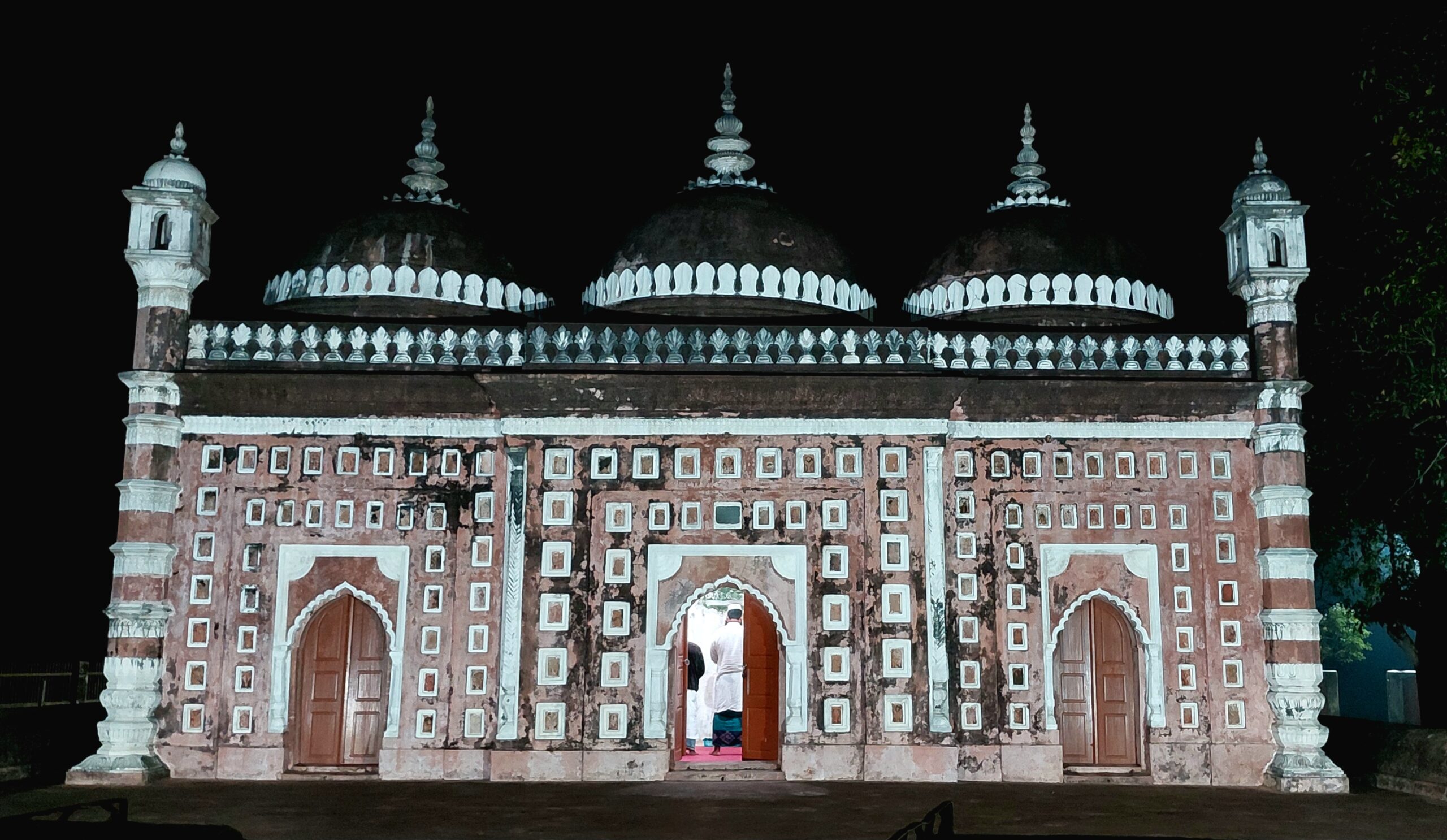
Architecturally, the Nayabad Mosque reflects the Mughal provincial style common to late-medieval Bengal. The structure is rectangular in plan, built with thick brick walls that ensure both durability and thermal comfort.
The mosque features:
- Three hemispherical domes crowning the roof
- Four corner towers (octagonal in shape) with finial tops
- Three arched entrances on the eastern façade
- Three mihrabs on the western wall, with the central one being more prominent
One of the mosque’s most striking features is its terracotta ornamentation. Floral motifs, creeping vines, geometric designs, and decorative borders once adorned the exterior walls. Although much of this detailing has eroded over time, the surviving fragments reveal a high level of craftsmanship.
Notably, the stylistic language of the mosque’s terracotta panels closely resembles that of Kantanagar Temple. This similarity strengthens the belief that the same group of artisans worked on both religious structures, adapting their artistic skills across religious contexts.
Cultural and Religious Significance
Beyond its function as a place of worship, Nayabad Mosque represents an important cultural bridge. It stands as evidence of a historical moment when religious communities were not isolated but interconnected through shared labor, aesthetics, and daily life.
The mosque illustrates how Muslim craftsmen played a crucial role in shaping Bengal’s architectural heritage, even within Hindu religious projects, and how their own sacred spaces emerged from that collaboration. In this sense, Nayabad Mosque embodies a lived history of coexistence rather than separation.
Local Legend and Oral Tradition
One of the most enduring and evocative aspects of Nayabad Mosque is the popular local legend surrounding its location.
According to oral tradition, when the Muslim construction workers requested land for a mosque, the zamindar did not allocate it through formal measurement. Instead, he ordered a dhak (traditional drum) to be beaten loudly. His instruction was symbolic yet decisive:
the boundary for the mosque would begin at the point where the sound of the drum could no longer be heard.
As the drum echoed across the landscape, the fading sound marked an invisible yet meaningful boundary. When the beats finally disappeared into silence, that location was chosen for the mosque’s construction.
While historians treat this account as folklore rather than documented fact, its cultural meaning is profound. The legend frames space through sound, power through listening, and authority through accommodation. It remains a key part of local identity and collective memory.
Myth, Memory, and Meaning
The story of the drumbeat—like many historical myths—may not be empirically verifiable, but it carries emotional truth. It reflects how communities remember fairness, negotiation, and the shaping of sacred space. The mosque, in this telling, was not imposed but earned through recognition of religious need.
Such myths enrich the historical narrative, allowing architecture to speak not only through bricks and domes, but through stories passed from generation to generation.
Present Condition and Legacy
Today, Nayabad Mosque continues to function as a place of prayer while also drawing visitors interested in history, architecture, and heritage tourism. Although time and weather have weakened parts of its terracotta surface, the structure remains largely intact.
The mosque’s greatest legacy lies not only in its age or design, but in what it represents: a moment in Bengali history where craftsmanship crossed religious lines, where faith was negotiated through space, and where a sacred threshold was believed to be drawn by the fading sound of a drum.
In an era marked by rigid boundaries and divided memories, Nayabad Mosque quietly endures—as a monument of shared history, layered belief, and cultural coexistence.